They Said Genesis Was Fiction—Then 17,000 Ancient Tablets Started Naming the Same Places
For a long time, critics leaned on one confident claim: the early chapters of Genesis are too vague, too symbolic, too disconnected from real history to be taken seriously. Names, locations, movements of people—supposedly invented long after the fact.
That confidence didn’t age well.
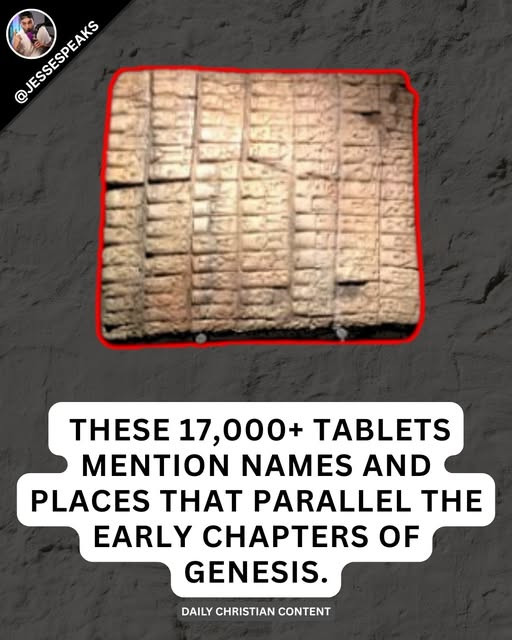
Archaeologists uncovered more than 17,000 ancient tablets from the Near East—administrative records, legal texts, correspondence, and travel documents—dating to the early second millennium BCE. These weren’t religious writings. They weren’t trying to validate Scripture. They were doing something far more inconvenient for skeptics: naming real people and real places.
And those names sound familiar.
Cities, regions, tribal designations, and geographic corridors mentioned on these tablets parallel the world of early Genesis—the same cultural and geographic landscape Abraham moves through. Trade routes. Border towns.
For a long time, critics leaned on one confident claim: the early chapters of Genesis are too vague, too symbolic, too disconnected from real history to be taken seriously. Names, locations, movements of people—supposedly invented long after the fact.
That confidence didn’t age well.
Archaeologists uncovered more than 17,000 ancient tablets from the Near East—administrative records, legal texts, correspondence, and travel documents—dating to the early second millennium BCE. These weren’t religious writings. They weren’t trying to validate Scripture. They were doing something far more inconvenient for skeptics: naming real people and real places.
And those names sound familiar.
Cities, regions, tribal designations, and geographic corridors mentioned on these tablets parallel the world of early Genesis—the same cultural and geographic landscape Abraham moves through. Trade routes. Border towns.
09:47 AM - Dec 31, 2025
Only people mentioned by myralynnr in this post can reply

Myra Raney
@myralynnr
31 December, 09:48
In response Myra Raney to her Publication
Population centers. All there. Quietly preserved in clay.
Genesis doesn’t read like myth when placed next to these records. It reads like a text that knows the terrain.
What’s striking is not that the names are identical word-for-word—languages shift, spellings change—but that the network of places makes sense together. The movement patterns described in Genesis align with known economic routes. The locations aren’t random. They form a coherent ancient world that archaeology now recognizes.
This is exactly what late fiction fails to do.
A writer inventing a story centuries later would get the big ideas right and the small details wrong. Genesis does the opposite. It gives unflattering family drama, morally complex decisions, and geographically accurate movement through a world that had been buried for thousands of years.
That’s not myth-making. That’s memory.
Genesis doesn’t read like myth when placed next to these records. It reads like a text that knows the terrain.
What’s striking is not that the names are identical word-for-word—languages shift, spellings change—but that the network of places makes sense together. The movement patterns described in Genesis align with known economic routes. The locations aren’t random. They form a coherent ancient world that archaeology now recognizes.
This is exactly what late fiction fails to do.
A writer inventing a story centuries later would get the big ideas right and the small details wrong. Genesis does the opposite. It gives unflattering family drama, morally complex decisions, and geographically accurate movement through a world that had been buried for thousands of years.
That’s not myth-making. That’s memory.
Notice: Undefined index: tg1tga_access in /home/admin/www/anonup.com/themes/default/apps/timeline/post.phtml on line 396
Myra Raney
@myralynnr
31 December, 09:48
In response Myra Raney to her Publication
Even more uncomfortable: these tablets were discovered independently, across different sites, studied by secular scholars, and translated without any interest in defending the Bible. Yet the overlap keeps appearing—not as theology, but as context.
Genesis never claimed to be a modern history textbook. It claimed to tell the story of real people in a real world. Archaeology is increasingly showing that the world Genesis describes is not imaginary—it’s ancient.
So the debate quietly shifts.
If early Genesis fits so naturally within the documented geography and naming conventions of its time, the question is no longer “Is it too ancient to be true?”
The question becomes:
How did it remember so much, so accurately, for so long?
Clay tablets don’t preach.
They don’t evangelize.
They just sit there—
and keep telling the same story.
Genesis never claimed to be a modern history textbook. It claimed to tell the story of real people in a real world. Archaeology is increasingly showing that the world Genesis describes is not imaginary—it’s ancient.
So the debate quietly shifts.
If early Genesis fits so naturally within the documented geography and naming conventions of its time, the question is no longer “Is it too ancient to be true?”
The question becomes:
How did it remember so much, so accurately, for so long?
Clay tablets don’t preach.
They don’t evangelize.
They just sit there—
and keep telling the same story.
Notice: Undefined index: tg1tga_access in /home/admin/www/anonup.com/themes/default/apps/timeline/post.phtml on line 396