PAINT LIKE AN EGYPTIAN
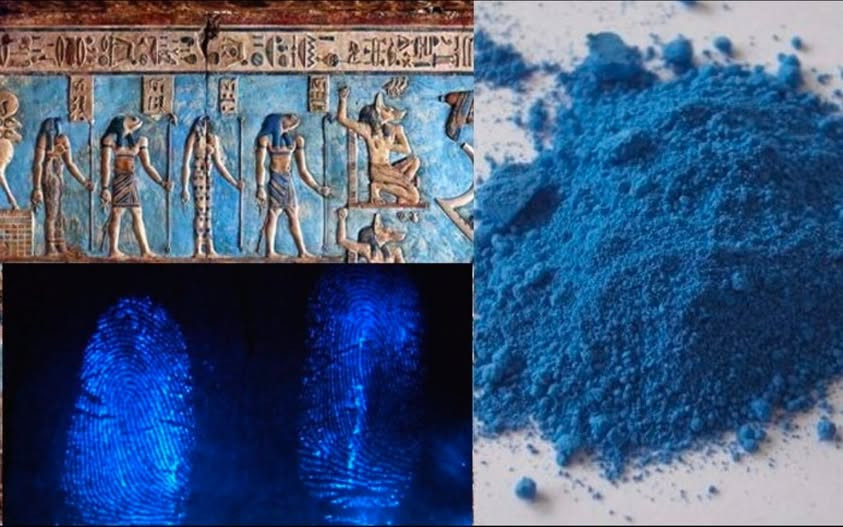
The brilliant blue seen on ancient Egyptian walls, coffins, and mummy masks still looks freshly painted today. This striking color, known as Egyptian blue, is considered the world’s first synthetic pigment. It was created nearly 4,000 years ago, yet the knowledge required to produce it was so advanced that it was completely lost by around the ninth century AD.
When a small container of Egyptian blue was uncovered at Pompeii in 1814, modern chemists were baffled. Reproducing it was not simple. It took more than a century of careful chemical investigation to discover that the pigment depended on blue crystals of calcium copper silicate, produced only by heating quartz, lime, and copper to about 1,000°C with an exact and controlled amount of alkali. This required high temperature manufacturing comparable to a glassworks, not primitive guesswork.
The brilliant blue seen on ancient Egyptian walls, coffins, and mummy masks still looks freshly painted today. This striking color, known as Egyptian blue, is considered the world’s first synthetic pigment. It was created nearly 4,000 years ago, yet the knowledge required to produce it was so advanced that it was completely lost by around the ninth century AD.
When a small container of Egyptian blue was uncovered at Pompeii in 1814, modern chemists were baffled. Reproducing it was not simple. It took more than a century of careful chemical investigation to discover that the pigment depended on blue crystals of calcium copper silicate, produced only by heating quartz, lime, and copper to about 1,000°C with an exact and controlled amount of alkali. This required high temperature manufacturing comparable to a glassworks, not primitive guesswork.
08:17 AM - Dec 29, 2025
Only people mentioned by myralynnr in this post can reply

Myra Raney
@myralynnr
29 December, 08:17
In response Myra Raney to her Publication
The resulting pigment was so chemically stable that it has remained unchanged for thousands of years under intense heat and sunlight. Modern researchers have since discovered that this same pigment even emits infrared light under certain conditions, a property now used to reveal faint details and fingerprints invisible to the naked eye.
The ancients were not crude or technologically ignorant. They possessed material knowledge and engineering precision that modern science is still working to fully understand. That should not surprise us, considering they descended from people who built an ocean liner sized Ark, carrying forward ingenuity from the earliest chapters of human history.
The ancients were not crude or technologically ignorant. They possessed material knowledge and engineering precision that modern science is still working to fully understand. That should not surprise us, considering they descended from people who built an ocean liner sized Ark, carrying forward ingenuity from the earliest chapters of human history.
Notice: Undefined index: tg1tga_access in /home/admin/www/anonup.com/themes/default/apps/timeline/post.phtml on line 396