In 2005, near Megiddo in northern Israel, archaeologists uncovered something that disrupted a popular modern narrative about Christianity.
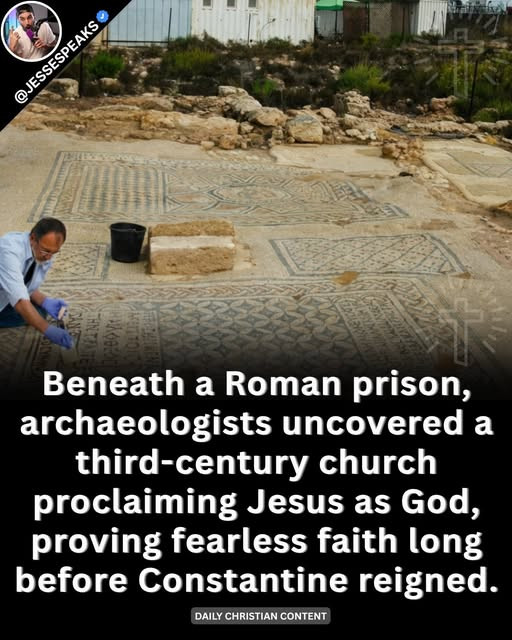
Hidden beneath the ground was a Christian church dating to around 230 AD—nearly a century before Constantine and long before Christianity was legalized or politically protected.
What stunned scholars was not just the building itself, but the words etched into its mosaic floor:
“To God Jesus Christ.”
This is the earliest known inscription explicitly declaring Jesus as divine. Not symbolic. Not vague. Direct worship—offered openly, clearly, and without apology.
The location makes the discovery even more striking.
This church was built inside a Roman military camp—the very system responsible for persecuting Christians. It was funded by women and a Roman centurion, names preserved in the mosaic, showing that faith had already crossed social, gender, and military boundaries.
Hidden beneath the ground was a Christian church dating to around 230 AD—nearly a century before Constantine and long before Christianity was legalized or politically protected.
What stunned scholars was not just the building itself, but the words etched into its mosaic floor:
“To God Jesus Christ.”
This is the earliest known inscription explicitly declaring Jesus as divine. Not symbolic. Not vague. Direct worship—offered openly, clearly, and without apology.
The location makes the discovery even more striking.
This church was built inside a Roman military camp—the very system responsible for persecuting Christians. It was funded by women and a Roman centurion, names preserved in the mosaic, showing that faith had already crossed social, gender, and military boundaries.
04:22 AM - Dec 28, 2025
Only people mentioned by myralynnr in this post can reply

Myra Raney
@myralynnr
28 December, 04:23
In response Myra Raney to her Publication
Surrounding the inscription were Ichthys (fish) symbols, a known marker of early Christian identity used when open faith could mean imprisonment or death.
This discovery dismantles the claim that Jesus was only later “made God” by political power. Long before emperors, councils, or creeds, ordinary believers were already worshipping Jesus as God—at great personal risk.
Christian faith did not begin as a tool of empire.
It began as a conviction strong enough to survive one.
This discovery dismantles the claim that Jesus was only later “made God” by political power. Long before emperors, councils, or creeds, ordinary believers were already worshipping Jesus as God—at great personal risk.
Christian faith did not begin as a tool of empire.
It began as a conviction strong enough to survive one.
Notice: Undefined index: tg1tga_access in /home/admin/www/anonup.com/themes/default/apps/timeline/post.phtml on line 396