
The Mac
@TheMac
15 February, 01:05
Notice: Undefined index: tg1tga_access in /home/admin/www/anonup.com/themes/default/apps/timeline/post.phtml on line 396

Leah Johnson
@RedPadawan
15 February, 08:56
In response The Mac to his Publication
Q: do you know how many 'fallen' angels there are (?)
and follow the white rabbit=adrenachrome
and follow the white rabbit=adrenachrome
Notice: Undefined index: tg1tga_access in /home/admin/www/anonup.com/themes/default/apps/timeline/post.phtml on line 396
The Mac
@TheMac
15 February, 10:12
In response Leah Johnson to her Publication
The apocryphal Books of Enoch (2nd–1st centuries BC) refer to both good and bad Watchers, with a primary focus on the rebellious ones.
Notice: Undefined index: tg1tga_access in /home/admin/www/anonup.com/themes/default/apps/timeline/post.phtml on line 396
The Mac
@TheMac
15 February, 10:13
In response The Mac to his Publication
A dilation response (mydriasis), is the widening of the pupil and may be caused by adrenaline, anti-cholinergic agents or drugs such as MDMA, cocaine, amphetamines, dissociatives and some hallucinogenics. Dilation of the pupil occurs when the smooth cells of the radial muscle, controlled by the sympathetic nervous system (SNS), contract.
Notice: Undefined index: tg1tga_access in /home/admin/www/anonup.com/themes/default/apps/timeline/post.phtml on line 396
The Mac
@TheMac
15 February, 10:15
In response The Mac to his Publication
The responses can have a variety of causes, from an involuntary reflex reaction to exposure or inexposure to light...
Notice: Undefined index: tg1tga_access in /home/admin/www/anonup.com/themes/default/apps/timeline/post.phtml on line 396
The Mac
@TheMac
15 February, 10:16
In response The Mac to his Publication
—in low light conditions a dilated pupil lets more light into the eye—or it may indicate interest in the subject of attention or arousal, sexual stimulation, uncertainty, decision conflict, errors or increasing cognitive load or demand.
The responses correlate strongly with activity in the locus coeruleus neurotransmitter system.
The responses correlate strongly with activity in the locus coeruleus neurotransmitter system.
Notice: Undefined index: tg1tga_access in /home/admin/www/anonup.com/themes/default/apps/timeline/post.phtml on line 396
The Mac
@TheMac
15 February, 10:17
In response The Mac to his Publication
Neurotransmitters are chemical messengers that transmit a signal from a neuron across the synapse to a target cell, which can be a different neuron, muscle cell, or gland cell. Neurotransmitters are chemical substances made by the neuron specifically to transmit a message.
Notice: Undefined index: tg1tga_access in /home/admin/www/anonup.com/themes/default/apps/timeline/post.phtml on line 396
The Mac
@TheMac
15 February, 10:20
In response The Mac to his Publication
There are many different ways to classify neurotransmitters. Dividing them into amino acids, peptides, and monoamines is sufficient for some classification purposes.
Notice: Undefined index: tg1tga_access in /home/admin/www/anonup.com/themes/default/apps/timeline/post.phtml on line 396
The Mac
@TheMac
15 February, 10:21
In response The Mac to his Publication
Peptides (from Greek language πεπτός, peptós "digested"; derived from πέσσειν, péssein "to digest") are short chains of between two and fifty amino acids, linked by peptide bonds. Chains of fewer than ten or fifteen amino acids are called oligopeptides, and include dipeptides, tripeptides, and tetrapeptides.
Notice: Undefined index: tg1tga_access in /home/admin/www/anonup.com/themes/default/apps/timeline/post.phtml on line 396
The Mac
@TheMac
15 February, 10:22
In response The Mac to his Publication
A polypeptide is a longer, continuous, unbranched peptide chain of up to approximately fifty amino acids. Hence, peptides fall under the broad chemical classes of biological polymers and oligomers, alongside nucleic acids, oligosaccharides, polysaccharides, and others.
Notice: Undefined index: tg1tga_access in /home/admin/www/anonup.com/themes/default/apps/timeline/post.phtml on line 396
The Mac
@TheMac
15 February, 10:27
In response The Mac to his Publication

Notice: Undefined index: tg1tga_access in /home/admin/www/anonup.com/themes/default/apps/timeline/post.phtml on line 396
The Mac
@TheMac
15 February, 10:31
In response The Mac to his Publication

Notice: Undefined index: tg1tga_access in /home/admin/www/anonup.com/themes/default/apps/timeline/post.phtml on line 396
The Mac
@TheMac
15 February, 10:32
In response The Mac to his Publication
Notice: Undefined index: tg1tga_access in /home/admin/www/anonup.com/themes/default/apps/timeline/post.phtml on line 396
The Mac
@TheMac
15 February, 10:36
In response The Mac to his Publication
Notice: Undefined index: tg1tga_access in /home/admin/www/anonup.com/themes/default/apps/timeline/post.phtml on line 396
The Mac
@TheMac
15 February, 10:37
In response The Mac to his Publication
Notice: Undefined index: tg1tga_access in /home/admin/www/anonup.com/themes/default/apps/timeline/post.phtml on line 396
The Mac
@TheMac
15 February, 10:38
In response The Mac to his Publication
Notice: Undefined index: tg1tga_access in /home/admin/www/anonup.com/themes/default/apps/timeline/post.phtml on line 396
The Mac
@TheMac
15 February, 10:41
In response The Mac to his Publication
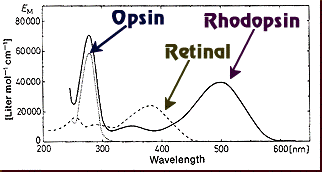
Rhodopsin, also called visual purple, pigment-containing sensory protein that converts light into an electrical signal.
Notice: Undefined index: tg1tga_access in /home/admin/www/anonup.com/themes/default/apps/timeline/post.phtml on line 396
The Mac
@TheMac
15 February, 10:43
In response The Mac to his Publication
Notice: Undefined index: tg1tga_access in /home/admin/www/anonup.com/themes/default/apps/timeline/post.phtml on line 396
The Mac
@TheMac
15 February, 10:44
In response The Mac to his Publication
As an excitatory neurotransmitter, glutathione depolarizes neurons by acting as ionotropic receptors of its own which are different from any other excitatory amino acid receptors.
Notice: Undefined index: tg1tga_access in /home/admin/www/anonup.com/themes/default/apps/timeline/post.phtml on line 396
The Mac
@TheMac
15 February, 10:46
In response The Mac to his Publication
Glutathione is involved in the disposal of peroxides by brain cells and in the protection against reactive oxygen species. In coculture astroglial cells protect other neural cell types against the toxicity of various compounds.
Notice: Undefined index: tg1tga_access in /home/admin/www/anonup.com/themes/default/apps/timeline/post.phtml on line 396
The Mac
@TheMac
15 February, 10:47
In response The Mac to his Publication

Notice: Undefined index: tg1tga_access in /home/admin/www/anonup.com/themes/default/apps/timeline/post.phtml on line 396
The Mac
@TheMac
15 February, 10:53
In response The Mac to his Publication
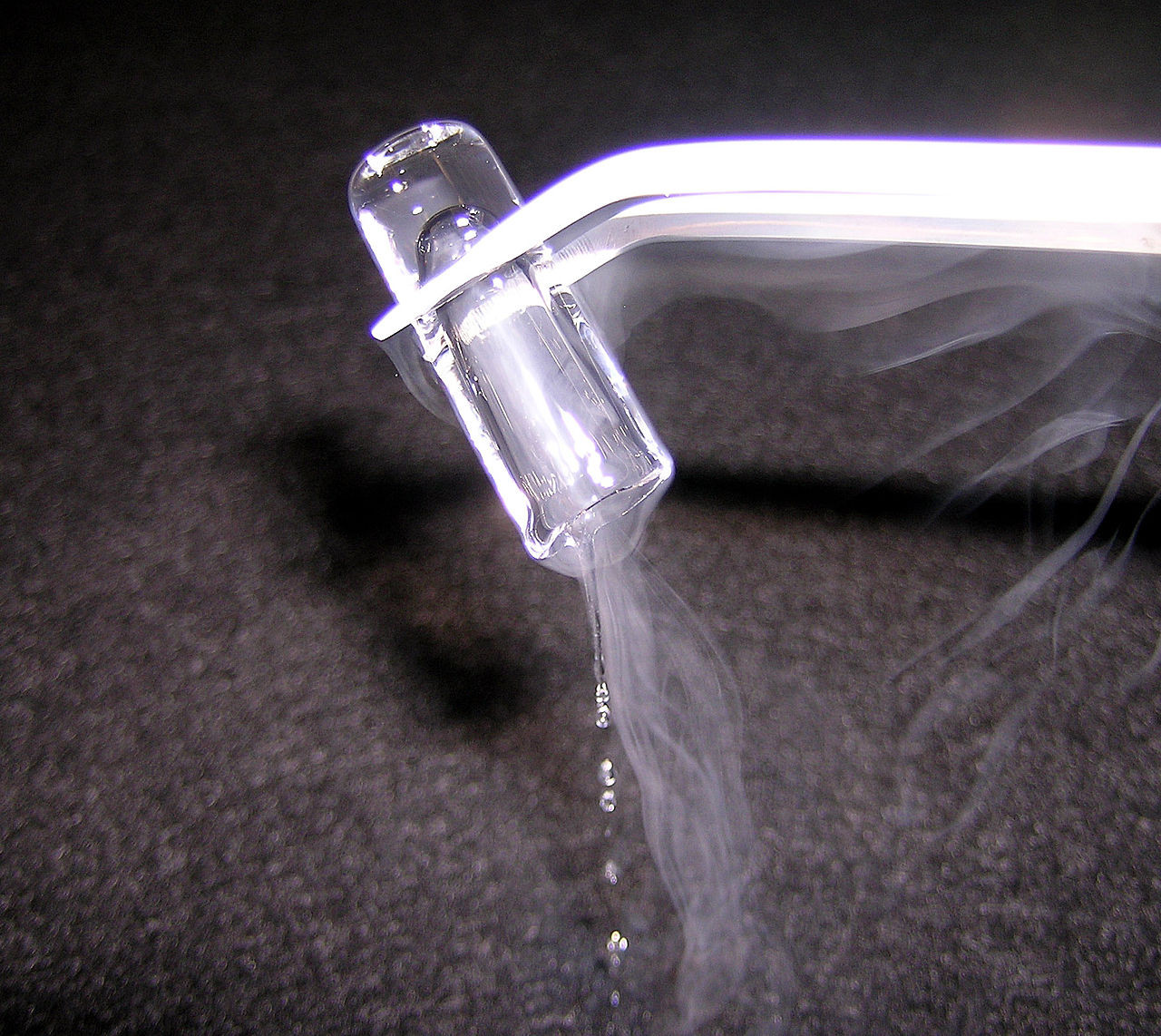
The term phase is sometimes used as a synonym for state of matter, but there can be several immiscible phases of the same state of matter. Also, the term phase is sometimes used to refer to a set of equilibrium states demarcated in terms of state variables such as pressure and temperature by a phase boundary on a phase diagram.
Notice: Undefined index: tg1tga_access in /home/admin/www/anonup.com/themes/default/apps/timeline/post.phtml on line 396
The Mac
@TheMac
15 February, 10:53
In response The Mac to his Publication
Because phase boundaries relate to changes in the organization of matter, such as a change from liquid to solid or a more subtle change from one crystal structure to another, this latter usage is similar to the use of "phase" as a synonym for state of matter. However, the state of matter and phase diagram usages are not commensurate with the formal definition given above and the intended meaning must be determined in part from the context in which the term is used.
Notice: Undefined index: tg1tga_access in /home/admin/www/anonup.com/themes/default/apps/timeline/post.phtml on line 396
The Mac
@TheMac
15 February, 10:57
In response The Mac to his Publication
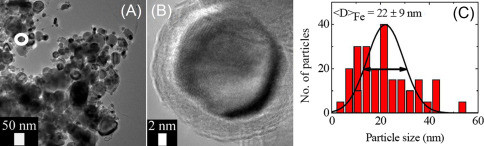
The phase structure and morphology of the synthesized MNPs are characterized usually by scanning electron microscopy (SEM), high-resolution transmission electron microscope (HR-TEM), and X-ray diffraction (XRD) patterns. For example, Fig. 2.2 shows TEM images of the synthesized Fe@C nanoparticles, the particles exhibit a core/shell structure of magnetic core of Fe coated with carbon shells. HR-TEM images are shown together with the resulting size distribution based on the TEM analysis.
Notice: Undefined index: tg1tga_access in /home/admin/www/anonup.com/themes/default/apps/timeline/post.phtml on line 396
As shown in Fig. 2.2A and B, the particles exhibit the desirable core/shell structure of carbon-coated MNPs. A typical example of the desired core/shell Fe@C particles is displayed in Fig. 2.2B which shows a spherical Fe nanoparticle of about 24 nm coated by 5 nm of carbon. The average size of the Fe particles in Fe@C amounts to 22 nm with a size distribution in the range 2–58 nm as presented in Fig. 2.2C. The phase structure measurements reveal pure Fe core with no peaks of related oxides.
10:59 AM - Feb 15, 2021
In response The Mac to his Publication
Only people mentioned by TheMac in this post can reply
The Mac
@TheMac
15 February, 11:00
In response The Mac to his Publication
A magnetic core is a piece of magnetic material with a high magnetic permeability used to confine and guide magnetic fields in electrical, electromechanical and magnetic devices such as electromagnets, transformers, electric motors, generators, inductors, magnetic recording heads, and magnetic assemblies.
Notice: Undefined index: tg1tga_access in /home/admin/www/anonup.com/themes/default/apps/timeline/post.phtml on line 396
The Mac
@TheMac
15 February, 11:01
In response The Mac to his Publication
It is made of ferromagnetic metal such as iron, or ferrimagnetic compounds such as ferrites. The high permeability, relative to the surrounding air, causes the magnetic field lines to be concentrated in the core material. The magnetic field is often created by a current-carrying coil of wire around the core.
Notice: Undefined index: tg1tga_access in /home/admin/www/anonup.com/themes/default/apps/timeline/post.phtml on line 396