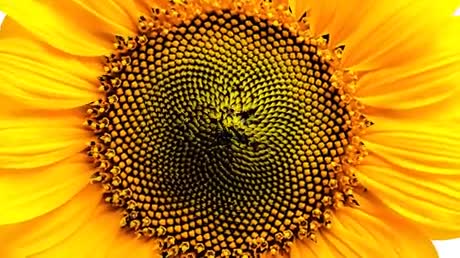
The Fibonacci series embodies the low of natural growth. In the fir-cone starting from the centre, a system of spirals runs in the right and left directions, in which the number of spirals always result in the values of the Fibonacci sequence: 3, 5, 8 and 13 spirals.
A similar setting can be seen on the sunflower, pineapple, chamomile, dandelion, marguerite, cactus, likewise in the arrangement of leaves on the stem and in the horns of some ruminating animals.
A similar setting can be seen on the sunflower, pineapple, chamomile, dandelion, marguerite, cactus, likewise in the arrangement of leaves on the stem and in the horns of some ruminating animals.
09:36 AM - Oct 11, 2021
Only people mentioned by QueenEsther in this post can reply

EK17 QKraken - Z
@GaDawg
11 October, 09:56
In response Serah Oceane ♡ to her Publication
This song was written and performed based on the Fibonacci Sequence. A masterpiece.
https://scholarhero.wordpr...
https://youtu.be/Y7JG63Iua...
https://scholarhero.wordpr...
https://youtu.be/Y7JG63Iua...

Notice: Undefined index: tg1tga_access in /home/admin/www/anonup.com/themes/default/apps/timeline/post.phtml on line 396

Serah Oceane ♡
@QueenEsther
11 October, 10:04
In response EK17 QKraken - Z to his Publication
Thank you for sharing it, I was just listening to them yesterday 😁
Notice: Undefined index: tg1tga_access in /home/admin/www/anonup.com/themes/default/apps/timeline/post.phtml on line 396
Serah Oceane ♡
@QueenEsther
11 October, 09:41
In response Serah Oceane ♡ to her Publication
The Fibonacci series covers the simplest golden section sequence which can be expressed in whole-numbers (the golden section of 89 being 55, and that of 55 being 34, etc.):
[2, 3, 5, 8, 13, 21, 34, 55, 89 …]
In it each number equals the sum of the two preceding numbers (that is, 2+3 =5, 3+5=8, 5+8=13, etc.).
The sequence approaches nearer and nearer the proportion of the geometrical golden section i.e. the irrational key-number of the geometric mean: the square of every number is equal to the product of the numbers preceding and following it - with the difference of + or - 1.
[2, 3, 5, 8, 13, 21, 34, 55, 89 …]
In it each number equals the sum of the two preceding numbers (that is, 2+3 =5, 3+5=8, 5+8=13, etc.).
The sequence approaches nearer and nearer the proportion of the geometrical golden section i.e. the irrational key-number of the geometric mean: the square of every number is equal to the product of the numbers preceding and following it - with the difference of + or - 1.
Notice: Undefined index: tg1tga_access in /home/admin/www/anonup.com/themes/default/apps/timeline/post.phtml on line 396