Genesis Was Called Myth—Until 20,000 Ancient Tablets Told the Same Story
For decades, critics confidently claimed that the book of Genesis was written far too late to reflect real ancient history. They argued its customs, laws, and family structures were invented by later Israelites trying to give themselves a backstory.
Then archaeologists uncovered the Mari Tablets.
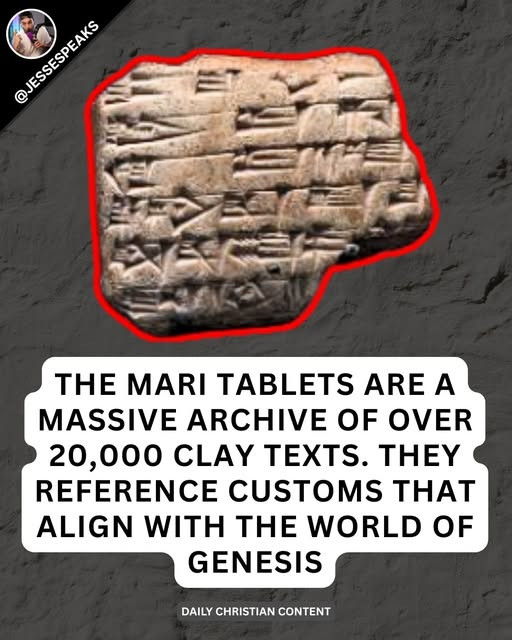
In the ruins of the ancient city of Mari (modern-day Syria), researchers discovered a massive archive of over 20,000 clay tablets, dating to around 1800 BCE—centuries before Moses, long before Israel existed as a nation. These tablets record everyday life: legal disputes, marriage contracts, inheritance laws, adoption customs, nomadic movements, covenants, and divine communication.
And here’s the problem for skeptics:
The world described in these tablets looks eerily like Genesis.
Not vaguely. Specifically.
For decades, critics confidently claimed that the book of Genesis was written far too late to reflect real ancient history. They argued its customs, laws, and family structures were invented by later Israelites trying to give themselves a backstory.
Then archaeologists uncovered the Mari Tablets.
In the ruins of the ancient city of Mari (modern-day Syria), researchers discovered a massive archive of over 20,000 clay tablets, dating to around 1800 BCE—centuries before Moses, long before Israel existed as a nation. These tablets record everyday life: legal disputes, marriage contracts, inheritance laws, adoption customs, nomadic movements, covenants, and divine communication.
And here’s the problem for skeptics:
The world described in these tablets looks eerily like Genesis.
Not vaguely. Specifically.
10:42 AM - Dec 30, 2025
Only people mentioned by myralynnr in this post can reply

Myra Raney
@myralynnr
30 December, 10:43
In response Myra Raney to her Publication
The Mari Tablets describe:
Patriarchal family authority identical to Abraham’s role
Adoption laws that explain why childless couples named heirs (Genesis 15)
Concubine arrangements mirroring Abraham, Hagar, Sarah, Jacob, and Rachel
Inheritance disputes resolved exactly as Genesis records
Covenant language using the same legal structure found in biblical covenants
Nomadic tribal leaders moving between cities, just like the patriarchs
These weren’t religious texts trying to prop up Scripture. They were administrative records—mundane, boring, brutally honest accounts of how life actually worked in the ancient Near East.
Which raises an uncomfortable question.
Patriarchal family authority identical to Abraham’s role
Adoption laws that explain why childless couples named heirs (Genesis 15)
Concubine arrangements mirroring Abraham, Hagar, Sarah, Jacob, and Rachel
Inheritance disputes resolved exactly as Genesis records
Covenant language using the same legal structure found in biblical covenants
Nomadic tribal leaders moving between cities, just like the patriarchs
These weren’t religious texts trying to prop up Scripture. They were administrative records—mundane, boring, brutally honest accounts of how life actually worked in the ancient Near East.
Which raises an uncomfortable question.
Notice: Undefined index: tg1tga_access in /home/admin/www/anonup.com/themes/default/apps/timeline/post.phtml on line 396
Myra Raney
@myralynnr
30 December, 10:43
In response Myra Raney to her Publication
How did Genesis—written down much later—get the details right?
The social customs in Genesis were once dismissed as “anachronistic.” But archaeology flipped the script. It turns out Genesis doesn’t reflect later Israelite culture at all. It reflects a much older world—the very one the Mari Tablets describe.
This is not copying mythology.
This is historical memory preserved with precision.
Even more unsettling for critics is what Genesis doesn’t do. It doesn’t sanitize its heroes. It doesn’t clean up morally questionable practices. It reports them plainly—exactly how an authentic ancient record would.
The Mari Tablets didn’t “prove the Bible” in a sermon-ready way. They did something worse for skeptics:
They removed the excuse that Genesis was ignorant of ancient history.
You don’t need faith to see the implication.
If Genesis accurately reflects the social, legal, and familial realities of a world buried for nearly 4,000 years—
The social customs in Genesis were once dismissed as “anachronistic.” But archaeology flipped the script. It turns out Genesis doesn’t reflect later Israelite culture at all. It reflects a much older world—the very one the Mari Tablets describe.
This is not copying mythology.
This is historical memory preserved with precision.
Even more unsettling for critics is what Genesis doesn’t do. It doesn’t sanitize its heroes. It doesn’t clean up morally questionable practices. It reports them plainly—exactly how an authentic ancient record would.
The Mari Tablets didn’t “prove the Bible” in a sermon-ready way. They did something worse for skeptics:
They removed the excuse that Genesis was ignorant of ancient history.
You don’t need faith to see the implication.
If Genesis accurately reflects the social, legal, and familial realities of a world buried for nearly 4,000 years—
Notice: Undefined index: tg1tga_access in /home/admin/www/anonup.com/themes/default/apps/timeline/post.phtml on line 396